
Spelt Sourdough
January 2026
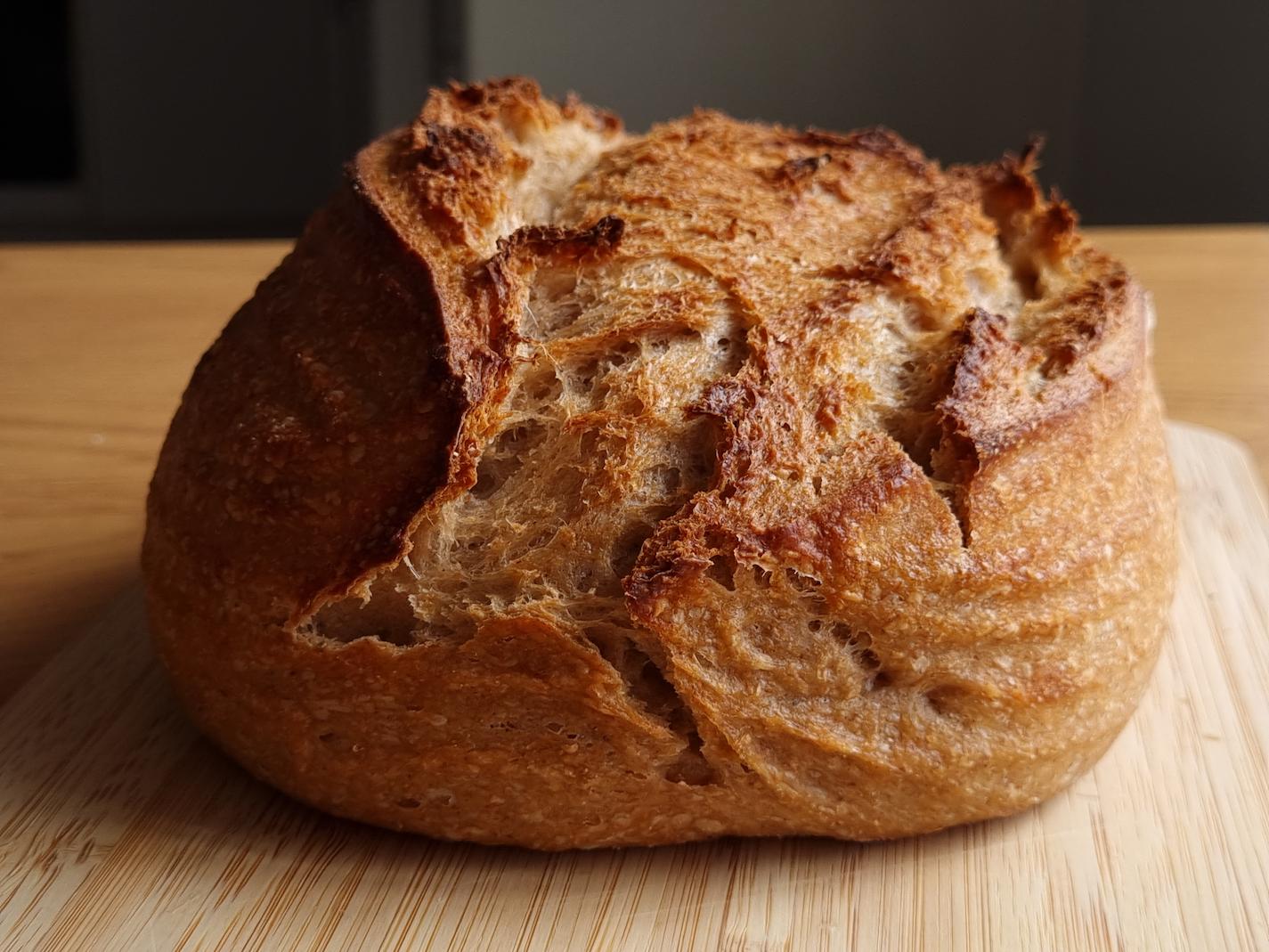
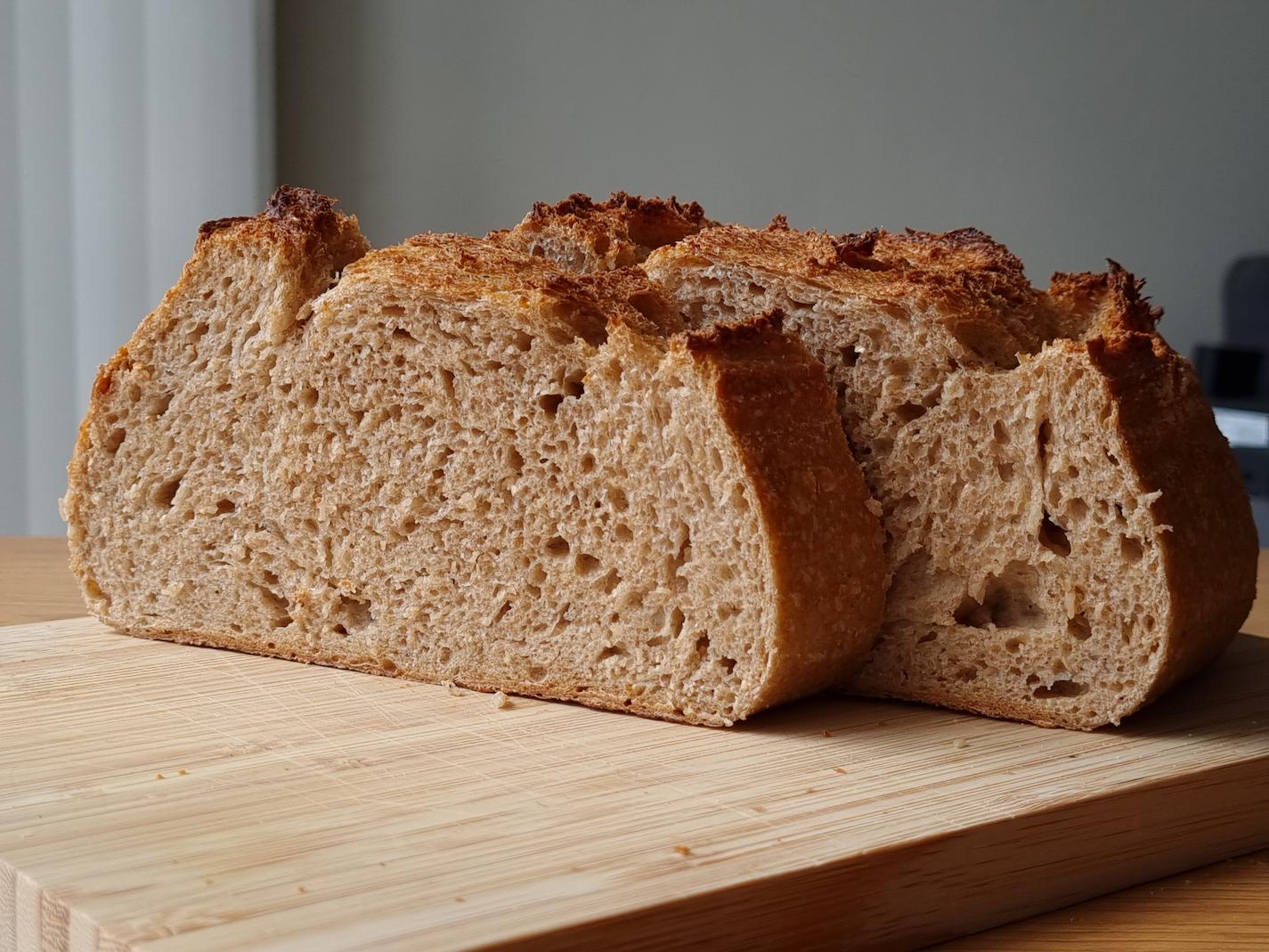
Considered the youngest of the ancient grains, spelt has been cultivated for over 7,000 years. While its gluten content is more delicate than modern varieties of wheat, its flavour is unmatched - rich, lightly sweet, and distinctively nutty. Though ancient, it's celebrated by modern bakers for creating a tender crumb and for its health benefits; many find it easier to digest.
This recipe uses 50% wholemeal spelt to create a delicious, nutrient-dense loaf without sacrificing the light, airy lift of perfect sourdough.
After mixing the ingredients, a small amount of leftover levain is left in the jar after using, so it can be perpetuated with the scrapings method. See the recipe notes on our Straightforward, Same-Day Sourdough for details on this technique.
Timings
This recipe uses an overnight cold proof to develop deeper, more complex flavours. This timeline provides a suggested schedule for this recipe.
Day 1
- 11:00pm - mix the levain
Day 2
- 11:00 am - mix the dough.
- 11:30 am - stretch and fold
- 12:00 pm - stretch and fold
- 12:30 pm - stretch and fold
- 01:00 pm - stretch and fold
- 03:30 pm - preshape
- 03:50 pm - shape and cold proof
Day 3
- 08:00 am - bake.
Baker's Percentages
Baker's percentages express each ingredient as a proportion of the total flour weight (including in the starter), making it easier to understand, scale and adjust recipes.
Levain
| Ingredient | Quantity |
|---|---|
| Sourdough starter (100% hydration) | 5.5g |
| White bread flour | 55g |
| Water, room temperature | 55g |
Dough
| Ingredient | Quantity | Total Levain | Total Recipe | Baker's Percentage |
|---|---|---|---|---|
| Levain | 100g | 0 | 0 | ~20%* (10% PFF**) |
| White bread flour | 67g | 50g | 117g | ~25% |
| Wholemeal spelt flour | 234g | 0 | 234g | ~50% |
| Wholemeal flour | 117g | 0 | 117g | ~25% |
| Water, room temperature | 302g | 50g | 352g | ~75% |
| Fine sea salt | 10g (~1 ½ tsp) | 0 | 10g | ~2% |
* Levain baker's percentage is calculated as total starter weight / total flour (including in the starter).
** PFF is Pre-Fermented Flour (flour in the starter / total flour).
Storing Sourdough
Homemade sourdough loaves won’t keep as long as store-bought bread (which contain preservatives), but they will last longer than homemade bread made with commercial yeast. This is thanks to sourdough’s natural acidity. Here are our top tips for storing sourdough.
- Always let the loaf cool completely before slicing or storing. This allows the internal structure to set and avoids a gummy texture.
- At room temperature, a sourdough loaf can keep for 3-5 days depending on the temperature and humidity.
- We don't recommend refrigeration as the loaf will stale faster than if stored at room temperature.
- For long term storage, freezing is truly the best option. Whole or sliced, frozen sourdough loaves will keep for 2-3 months. Our favourite method is to pre-slice the loaf, place a piece baking paper in between each slice, then freeze. This allows you to grab exactly what you need, and pop it into the microwave or toaster.
Spelt Sourdough
Makes one loaf (830g dough) with enough leftover starter to refeed with the scrapings method.
Special Equipment
Ingredients
For the levain
For the dough
Method
This recipe is based on a room temperature and Desired Dough Temperature of 24C. If your kitchen is warmer or cooler, the dough may proof faster or slower. Adjust the timing and/or levain amount as needed.
Day 1
- Combine 5.55g active sourdough starter with 55g white bread flour and 55g water. Let sit overnight for 10-12 hours until it peaks - doubling or tripling in size with lots of small surface bubbles.
Day 2
- In a bowl (or preferably a straight-sided container so you can observe the rise), combine 100g of the levain, 67g white bread flour, 234g wholemeal spelt flour, 117g wholemeal flour, 302g water and 10g fine sea salt. Mix by hand, folding the dough over itself until the ingredients are well combined. Cover and let rest (fermentolyse) for 30 minutes, to hydrate the flour and begin gluten development. If using a straight-sided container, mark the height of the dough.
- Perform four sets of stretch and folds, spaced 30 minutes apart.
- Let the dough rise until it has increased in size by 50%, about 4-5 hours after the initial mix.
- Lightly flour the top of the dough and your work surface. Turn out the dough and gently preshape. Fold in the sides of the dough to the centre, rotating and repeating all the way around until it forms a ball. Flip over so it's resting on its seam and let rest, uncovered for 20 minutes.
- Shape the dough. Flip the dough back so the seam side is up and gently stretch into a rectangle. Fold one long side toward the centre, then fold the other side so they meet in the middle. Roll the dough top down, creating tension, flip seam side up and pinch the seam to seal. Tuck in or seal the ends. Flour a banneton, place the dough seam-side up and cover. Refrigerate for 12-22 hours.
Day 3
- 30 minutes before baking, preheat the oven to 220C conventional mode, with a Dutch oven inside. If using fan mode, preheat to 220C and reduce to 200C for the second half of the bake after removing the lid.
- Flip the dough out onto a piece of baking paper and score. Carefully transfer the dough using the baking paper into the Dutch oven with an ice cube for steam. Bake for 20 minutes, then carefully remove the lid and bake a further 25 minutes until the crust reaches your preferred colour.
- Transfer to a wire rack and let cool for at least 1 hour before slicing.